

If you need a walk-in emergency dentist near you right now, do this first: call your regular dentist and say it is urgent — most practices hold same-day emergency slots. If you cannot reach them, call NHS 111 in the UK (free, 24/7) or use the American Dental Association’s Find-a-Dentist tool in the US. A knocked-out adult tooth is the one emergency where minutes matter: it should be seen within about an hour, ideally within 30 minutes.


At a glance: Most dental emergencies — severe toothache, a broken tooth, a lost crown, a dental abscess — need a dentist the same day, not an ambulance. Call your dentist first, then NHS 111 (UK) or an emergency dental clinic (US) if you cannot reach them. Go to the emergency room or call 911 (US) / 999 (UK) only if swelling affects your breathing or swallowing, bleeding will not stop, or you have a serious face or jaw injury. A knocked-out adult tooth should be seen within an hour — hold it by the crown, keep it moist in milk, and get to a dentist immediately.
This article is general information only and is not medical or dental advice. If you are in severe pain, have facial swelling, a fever, or difficulty breathing or swallowing, seek professional care immediately — call your dentist, NHS 111, or emergency services rather than relying on anything you read here.
What Counts as a Dental Emergency?
Not every tooth problem is an emergency, but the ones below need a dentist promptly — usually the same day. Dental guidance distinguishes true emergencies, which need help within the hour, from urgent problems, which need a dentist within about 24 hours, and non-urgent problems, which can usually wait up to 7 days — the time frames used by the Scottish Dental Clinical Effectiveness Programme (SDCEP). The NHS triages similarly: a knocked-out adult tooth should be offered emergency care within 1 hour; other urgent problems typically within 24 hours to 7 days.
| Problem | How urgent is it? | What to do |
|---|---|---|
| Knocked-out adult tooth | Emergency — within the hour | See the first-aid steps below; get to a dentist immediately |
| Severe toothache not controlled by painkillers | Urgent — same day | Call a dentist; use NHS 111 if you cannot reach one |
| Facial swelling, abscess, or fever with toothache | Urgent — same day | Call a dentist now; go to A&E/ER if swelling affects breathing or swallowing |
| Broken tooth with severe pain or a sharp edge | Urgent — same day | Call a dentist; save any fragments; avoid chewing on that side |
| Bleeding that will not stop after an extraction or injury | Emergency — now | Apply firm pressure with gauze; go to the ER/A&E if it does not stop |
| Lost filling or crown, mild discomfort | Non-urgent — within days | Call your dentist for a routine appointment |
| Chipped tooth, no pain | Non-urgent — within days | Call your dentist; a chip alone is rarely an emergency |
A dental abscess deserves special attention. It is an infection at the root of a tooth or in the gum, and it will not go away on its own. The warning signs are a throbbing toothache, swelling in the face or gum, a bad taste in the mouth, and sometimes a fever. If the swelling is spreading, get seen the same day.
When Is It a Medical Emergency? Go to the ER or A&E
Some dental problems are medical emergencies that belong in a hospital, not a dental chair. Go to the emergency room (US) or A&E (UK), or call 911 / 999, if you have any of these:
- Swelling in your mouth, neck or face that makes it difficult to breathe, swallow or speak
- Swelling around your eye or spreading into your neck
- Heavy bleeding from your mouth that will not stop after firm pressure
- A serious injury to your face, jaw or teeth — for example, a suspected broken jaw, or a jaw that will not open or close
- A high fever with facial swelling
The NHS gives the same guidance for toothache: go to A&E if the area around your eye or neck is swollen, or if swelling in your mouth or neck is making it difficult to breathe, swallow or speak. Do not drive yourself if you have any of these symptoms. One common mistake is going to a GP (in the UK) for a dental problem — GPs are not trained to treat dental emergencies and cannot offer urgent dental care. Call a dentist or NHS 111 instead.
Knocked-Out Tooth: First Aid That Can Save It
A completely knocked-out (avulsed) permanent tooth is the most time-sensitive dental emergency there is. The tooth’s best chance of survival is reinsertion within about 30 minutes, and the general window is roughly 30 to 60 minutes, according to Mayo Clinic guidance. A tooth left dry for over an hour is unlikely to survive, and a dry time of over 20 minutes sharply lowers the odds. The NHS advises that a knocked-out adult tooth should be seen within about an hour. Follow these steps, drawn from the ADA’s MouthHealthy guidance, the NHS and Mayo Clinic:
- Pick the tooth up by the crown — the white, visible part — never by the root. The delicate ligament cells on the root surface are what allow the tooth to reattach, and touching or scrubbing them damages them.
- If it is dirty, rinse it briefly. A quick rinse in milk, saline or saliva is best; a rinse under cold water for no more than 10 seconds is acceptable. Do not scrub it, do not use soap, and do not remove any attached tissue.
- Try to put it back in the socket. If the person is calm and able to cooperate, gently push the tooth back into place facing the right way, then bite down softly on a clean cloth or gauze to hold it there.
- If it will not go back in, keep it moist. Place it in a small container of cold milk, hold it between the cheek and gum, or use an over-the-counter tooth-preservation product carrying the ADA Seal of Acceptance. Milk is preferred over water because its pH and mineral balance are gentler on the root cells. Never let the tooth dry out, and never store it in plain water for long.
- Get to a dentist immediately and tell them you are coming with a knocked-out tooth so they can prepare. Even if the tooth is replanted successfully, it will usually need root canal treatment soon afterwards, and it can take weeks to reattach.
One important exception: never try to reinsert a knocked-out baby tooth. Doing so can damage the permanent tooth developing underneath. Take the child to a dentist as soon as you can, and bring the tooth along.
How to Find a Walk-In Emergency Dentist Near You
If you have a regular dentist
Call them first, even outside normal hours. Most practices keep same-day slots for emergencies, and many have an out-of-hours message directing you to an on-call dentist or urgent-care service. Say clearly what happened, how bad the pain is, and whether there is swelling or bleeding — the practice triages on that information.
In the UK: NHS 111 and urgent dental care
If you do not have a dentist, cannot reach yours, or need help out of hours, call NHS 111 (free, 24 hours a day, 7 days a week) or visit 111.nhs.uk. NHS 111 will assess your symptoms and can book you into an urgent dental service or an urgent dental access centre, often within a few hours. You do not need to be registered with a dentist to use NHS 111. You can also search for an NHS dentist directly at nhs.uk/service-search/find-a-dentist and ask whether they offer emergency appointments.
Urgent NHS dental treatment in England is charged at Band 1 — £27.90 as of April 2026 — which covers the emergency examination, X-rays, pain relief and temporary treatment, unless you are entitled to free NHS dental treatment. Private emergency appointments cost more and vary by clinic, so ask for the fee before you attend.
In the US: same-day and walk-in clinics
In the US, start with your regular dentist, then look for practices advertising same-day emergency appointments or walk-ins during business hours. Many general dentists reserve emergency slots each day and will see a new patient the same day for severe pain or trauma. The ADA’s MouthHealthy site offers a Find-a-Dentist tool for locating a dentist near you, which is useful if you are travelling or new to an area. Dental schools and community health centres can also be options for urgent care at lower cost. If it is late at night and no dentist is reachable, an urgent-care clinic or hospital ER can manage pain and infection, but they generally cannot perform dental treatment itself.
What to check before you go
- Call ahead, even for a walk-in. Calling first lets the clinic prepare, confirms they are open, and tells you the likely wait.
- Confirm they treat your problem. Describe your symptoms on the phone; some clinics refer trauma cases elsewhere.
- Ask about cost and insurance. In the US, emergency visit fees vary widely by region and treatment — ask for the exam fee and whether they accept your insurance before you arrive. In the UK, confirm whether the appointment is NHS or private.
- Bring your details. ID, insurance information, a list of medicines you take, and any allergies — especially to antibiotics or anaesthetics.
What Happens at an Emergency Dental Visit?
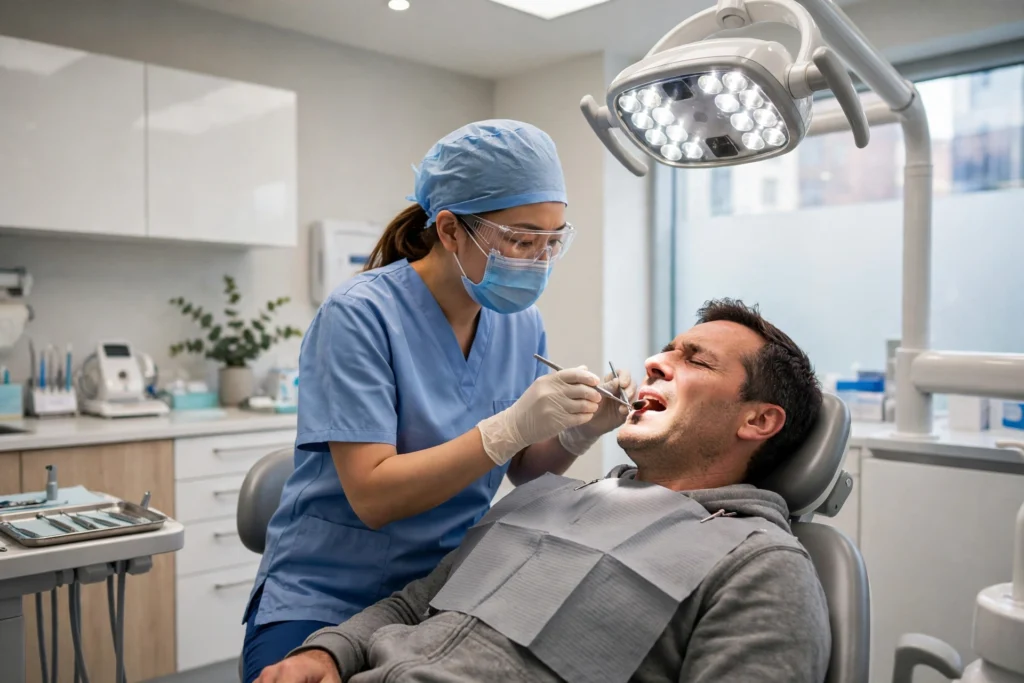
The first job is to get you out of pain. Expect an examination, usually with an X-ray, to find the cause. Treatment on the day is often aimed at stabilizing the problem rather than finishing it: draining an abscess, prescribing antibiotics for a spreading infection, placing a temporary filling, or splinting a replanted tooth. Definitive treatment — a root canal, a crown, or an extraction — may be scheduled as a follow-up once the pain and infection are under control. If your emergency visit does lead to a root canal, our guide to root canal treatment side effects explains what recovery usually involves. For the broader picture on finding a dentist who accepts walk-ins, see our guide to a walk-in dentist near me.
Pain Relief While You Wait

While you arrange care, the ADA’s 2024 guideline for ages 12 and older recommends an NSAID such as ibuprofen or naproxen as the first choice for dental pain, alone or with acetaminophen (paracetamol), when those medicines are safe for you. If you cannot take NSAIDs, acetaminophen alone is the usual alternative. Always follow the packet instructions.
A few practical steps help while you wait: rinse with warm water (a warm salt-water rinse — half a teaspoon of salt in a glass of warm water — can help adults), avoid chewing on the painful side, and hold a cold compress against the outside of your cheek for swelling. The ADA’s MouthHealthy guidance is clear on one old remedy: do not put aspirin directly on the aching tooth or gum — it can burn the tissue and cause mouth ulcers. Aspirin is meant to be swallowed. And do not take leftover antibiotics — they may be the wrong drug and they do not fix the cause.
Frequently Asked Questions
Can I just walk into a dentist with an emergency?
Many dental practices accept walk-in emergency patients during business hours, and most keep same-day emergency slots. Call ahead anyway: it confirms they are open and gets you triaged faster. If no dentist is reachable, call NHS 111 in the UK or go to an urgent-care clinic or ER in the US for pain and infection management.
How fast do I need to see a dentist for a knocked-out tooth?
As fast as possible — the best chance of saving a knocked-out adult tooth is reinsertion within about 30 minutes, and the window is roughly 30 to 60 minutes (Mayo Clinic). The NHS advises that a knocked-out adult tooth should be offered emergency dental care within 1 hour. Hold the tooth by the crown, keep it moist in milk, and get to a dentist immediately. Never reinsert a baby tooth.
What counts as a dental emergency?
A dental emergency is a problem that needs care within hours: severe toothache not controlled by painkillers, a dental abscess with swelling or fever, a knocked-out or badly broken tooth, or bleeding that will not stop. A chipped tooth without pain, or a lost filling with only mild discomfort, is usually urgent rather than an emergency and can wait a few days.
Should I go to the ER or a dentist for tooth pain?
For tooth pain without red-flag symptoms, a dentist is the right place to start. Go to the ER or A&E — or call 911 / 999 — if swelling affects your breathing or swallowing, swelling is around your eye or spreading into your neck, bleeding will not stop, or you have a serious face or jaw injury.
How much does an emergency dentist cost?
In England, urgent NHS dental treatment costs £27.90 (Band 1) as of April 2026, unless you are exempt from charges. Private emergency fees vary by clinic. In the US, emergency visit costs vary widely by region and treatment, so ask for the exam fee and whether your insurance is accepted before you arrive.
What should I do for a toothache at night?
Take pain relief as directed on the packet (an NSAID such as ibuprofen, alone or with acetaminophen, is the ADA’s first-choice recommendation for ages 12 and older), rinse with warm water, avoid chewing on the painful side, and use a cold compress for swelling. Then call your dentist first thing in the morning — or NHS 111 in the UK, which is available 24/7. Go to the ER or A&E if swelling affects breathing or swallowing.
Bottom Line
A walk-in emergency dentist is closer than most people think: your regular dentist first, NHS 111 or a same-day emergency clinic if you cannot reach them, and the ER only for the red-flag symptoms that threaten breathing, swallowing or life. The one rule that changes outcomes is speed for a knocked-out tooth — 30 to 60 minutes is the window, and milk, not water, is what keeps it alive on the way there.
Sources: NHS guidance on toothache and urgent dental care (nhs.uk and NHS integrated care board pages); American Dental Association, MouthHealthy — Dental Emergencies; ADA 2024 clinical practice guideline on managing acute dental pain; Mayo Clinic, “Taking it on the chin: How to manage dental trauma” (2022); NHS dental charges in England from April 2026. Figures verified as of November 2026. This article is general information, not medical advice.
