The short answer: The fastest way to find Black barbershops near you is to search “black barbershops near me” on Google Maps, then check each shop’s reviews, photos of recent fades, and booking options — or use a booking app such as Booksy to filter by service, price and availability. As of November 2026, a standard men’s haircut at a US barbershop typically costs $30–$65, a beard trim $20–$40, and a haircut-and-beard combo $50–$90, according to Booksy marketplace data. Prices vary by city and by barber, so always confirm the price on the shop’s own listing before you book.
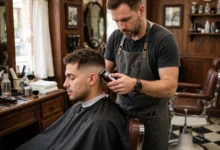
A Black barbershop is more than a place to get a haircut. For well over a century, these shops have been community institutions — places built on precision with textured and Afro hair, and on trust between barber and client. If you are new to an area, or trying a Black barbershop for the first time, this guide explains what makes these shops different, how to find a good one near you, what services and prices to expect, and what the experience is actually like once you sit in the chair.
At a Glance: Finding Black Barbershops Near Me
- Fastest way to find one: Search “black barbershops near me” on Google Maps, or filter by “Black-owned” and service on booking apps such as Booksy
- What they specialise in: Precision fades, tapers and line-ups on textured, curly and coily hair; beard shaping and hot-towel finishes
- Typical US prices (as of November 2026): Haircut $30–$65; beard trim $20–$40; haircut + beard combo $50–$90 (Booksy marketplace averages — prices vary by city and barber)
- Walk-in or appointment? Many shops take both, but the best barbers often book up — check the shop’s booking page first
- What to check before you go: Recent photos of fades, real customer reviews, whether the shop is Black-owned, and the price list
- Why it matters: The Smithsonian’s National Museum of African American History and Culture describes the barbershop as a place where “Black people could be vulnerable and talk about issues of importance in the community”
What Makes a Black Barbershop Different?
The first thing to understand is that “Black barbershop” describes a craft tradition, not just a customer base. Black barbershops are known for precision with textured and Afro hair — hair that behaves very differently from straight hair under the clippers. A skin fade on coily hair, a sharp line-up, a taper that blends cleanly into a natural curl pattern: these are specialist skills, learned over years of practice, and the reason many clients travel across town to a particular chair.
The second difference is the room itself. Booksy, the booking platform, describes Black barbershops as community spaces “built on trust and skill” with “a rich cultural tradition that goes well beyond the haircut.” That tradition has deep roots. Enslaved Black men were often valued for their grooming skills and worked as barbers — one of the few trades that offered any economic footing at all — and after emancipation in the mid-1800s, Black barbers began opening their own shops to serve their own communities, turning grooming into a foothold for entrepreneurship, identity and self-determination, according to the National Association of Barbers. The Smithsonian Institution holds whole archival collections documenting this history, including the papers of Washington, D.C. barber Nathaniel Mathis, who opened his first shop in 1969 and went on to popularise the Afro and cornrows as expressions of Black empowerment.
That history is still visible in the shop today — the conversation, the music, the dominoes and chess games, the arguments about sport and neighbourhood news. The barbershop has long doubled as an unofficial town hall, and films from Coming to America to Barbershop have picked up on exactly that.
How Do I Find Black Barbershops Near Me?
Finding a good shop is a search problem with a simple method. Here is the approach that works best, step by step.
Start with Google Maps. Search “black barbershops near me” or “Black-owned barbershop” plus your city or neighbourhood. Maps will show you distance, hours, photos, and — most usefully — the review count and rating. A shop with hundreds of reviews and a 4.5-star average is a safer bet than one with three reviews, however good they are.
Filter on a booking app. Booksy lets you search for barbers in your area and filter by location, service type, price and availability. Every barber profile includes real customer reviews, photos of their work, and live booking availability, so you can compare before you commit. Other apps and sites, including Yelp and StyleSeat, work the same way.
Look at the photos, not just the stars. For a fade or a line-up, photos are the real evidence. Look for recent pictures of cuts on hair like yours: clean blends, sharp edges, even tapers. If a shop’s photos are all stock images, or years old, treat that as a warning sign. Instagram is often the best portfolio — many barbers post their daily work there under the shop’s name or their own handle.
Ask around. Word of mouth still matters more in barbershops than in almost any other local service. If you see someone with a sharp fade, ask where they go — and in a new city, community groups and neighbourhood pages will usually name the same two or three shops again and again.
Check the basics before you travel. Confirm the shop’s hours, whether it takes walk-ins or appointments only, and whether your preferred barber works that day — a wasted trip is the most common first-visit mistake.
What Services Do Black Barbershops Offer?

Most Black barbershops offer a core menu built around precision cutting and beard work. The exact names vary by shop, but the services below are the standard ones you will see on price lists across the United States as of November 2026.
Signature cut or precision cut. A full haircut tailored to your head shape, hair texture and style — consultation, cut, and usually a hot-towel finish and styling. Prices commonly start around $40–$60 in major cities.
Skin fade / bald fade. The fade is blended down to the skin with a seamless transition and a sharp razor line-up. This is the signature service of the Black barbershop, and it is where a barber’s skill is most visible. Prices typically start around $43–$60.
Line-up / edge-up. A clean edge-up along the hairline and temples, with a razor finish, without a full haircut. A quick service, usually $20–$30, and the most common “between cuts” visit.
Beard trim and shape. Shaping, detailing and conditioning of the beard, often with a straight-razor finish on the cheek line and beard oil. Typically $20–$45, or $30–$40 for a detailed trim.
Haircut and beard combo. The full service: cut plus beard shape and trim in one sitting, usually 50–75 minutes. Typically $50–$90.
Kids’ cuts and senior cuts. Many shops offer patient, precise cuts for children (often from around $30) and discounted cuts for seniors (often from around $25). Some shops also offer hot-towel shaves and full grooming packages.
How Much Does a Black Barbershop Cost in 2026?
Prices vary more by city than by anything else — a fade in Los Angeles costs more than a fade in a small town — but the national picture is consistent. According to Booksy marketplace data, average US price ranges as of November 2026 are:
| Service | Typical US price range | Typical time |
|---|---|---|
| Men’s haircut (classic or fade) | $30–$65 | 30–60 minutes |
| Beard trim and shape | $20–$40 | 20–40 minutes |
| Haircut + beard combo | $50–$90 | 50–75 minutes |
Real shop price lists show the same pattern. At Black Hollywood in Los Angeles, a signature cut starts at $55, a skin fade at $60, and a beard trim and line-up at $30. At Altamonte City Fades in Florida, a line-up starts at $20, a kids’ haircut at $30, and a haircut with beard at $40. At Black Owl Barber Company, a haircut starts at $43 and a beard trim at $30. All prices are as listed on the shops’ own websites in November 2026.
Three things move the price: the city, the barber’s experience and reputation, and add-ons such as a hot-towel shave or a razor finish. Always check the exact price on the service listing before booking. Tipping is customary in the United States: 15–20% is standard for a good cut, more if your barber spent extra time or fitted you in at short notice.
How Do I Choose the Right Barber?

Once you have a shortlist of shops, choosing the barber matters as much as choosing the shop. A few checks will save you a bad cut.
Match the barber to the cut. Barbers have specialties — one may be famous for skin fades, another for beard sculpting, another for kids’ cuts. Look at each barber’s own photos and reviews rather than the shop’s overall rating.
Read the recent reviews properly. Ignore the one-line five-star reviews and the one-line one-star reviews. Look for detailed recent reviews that mention the cut by name — “best mid fade I’ve had,” “line-up stayed sharp for two weeks” — and note how the shop responds to complaints. A shop that answers criticism politely is a shop that cares about keeping clients.
Book a consultation cut first. If you are trying a new barber, start with a standard cut rather than a dramatic change, and use the visit to judge the consultation: a good barber asks about your hair and routine — and tells you honestly if a style will not work with your hair type.
Check the licence and the hygiene. A legitimate shop displays barber licences and keeps tools clean. If the shop looks dirty or the tools look neglected, leave — your health is worth more than a cheap fade.
Mind the clock. A precision fade takes 30–60 minutes — if a shop promises one in 15, something is being rushed. And a shop that runs an hour late every time is telling you how it values your time.
What Should I Expect on My First Visit?
If you have never been to a Black barbershop, the atmosphere can feel different from a salon or a chain haircut place — and that is part of the appeal. Expect conversation: about sport, music, local news, and anything else. Expect to wait a little even with an appointment, because a good barber does not rush the client in the chair before you. Expect to be asked what you want in plain terms — “what are we doing today?” — and expect an honest answer if your request does not suit your hair.
A few practical tips for a first visit: bring a photo of the cut you want, ideally from two or three angles and on hair like yours. Arrive on time, and tell the barber upfront about any problem areas — a cowlick, a scar, a patch that grows differently. Pay attention to how the barber handles your hairline: a good line-up follows your natural hairline rather than pushing it back. If you like the result, book your next visit before you leave — the best barbers’ books fill up fast.
Why Are Black Barbershops Important to the Community?
The barbershop’s role in Black American life goes far beyond grooming, and it is worth understanding before you walk in. The Smithsonian’s National Museum of African American History and Culture describes the barbershop as a place where “Black people could be vulnerable and talk about issues of importance in the community” — a rare room, historically, where that was possible without an outside audience. In the nineteenth century, as historian Douglas Bristol Jr. has documented, Black barbers were among the most successful African American businessmen in the country — on the eve of the Civil War, one in eight affluent African Americans in the upper South owned a barbershop.
That economic story continued into the twentieth century. Barbershops were among the few Black-owned businesses that could thrive under segregation, because they served a community that white-owned shops would not serve well — or at all. Barbers became employers, mentors and neighbourhood figures. The Smithsonian’s archives preserve that legacy in detail, including the papers of Washington barber Nathaniel Mathis, who helped popularise the Afro and cornrows and spent decades mentoring young people in his community.
Today the tradition continues in a different form. The modern Black barbershop is a small business, a training ground, and a social hub at the same time — and when you book a chair there, you are supporting that whole structure, not just buying a haircut.
Frequently Asked Questions
How do I find Black barbershops near me?
Search “black barbershops near me” on Google Maps, or use a booking app such as Booksy and filter by location, service and price. Check each shop’s reviews and recent photos of fades, and confirm hours and whether the shop takes walk-ins or appointments before you go.
How much does a haircut cost at a Black barbershop?
As of November 2026, a standard men’s haircut typically costs $30–$65 in the United States, a beard trim $20–$40, and a haircut-and-beard combo $50–$90, according to Booksy marketplace data. Prices vary by city and by barber, so check the shop’s own price list before booking.
What is a skin fade?
A skin fade — also called a bald fade — is a haircut in which the hair is blended down to bare skin at the sides and back, with a seamless transition up to longer hair on top and a sharp razor line-up. It is the signature service of most Black barbershops and typically takes 45 minutes.
Do Black barbershops take walk-ins?
Many do, but it depends on the shop. Some shops are walk-in only, some are appointment only, and many take both — with appointments recommended for a specific barber. Check the shop’s booking page or call ahead, especially on Fridays and Saturdays, which are the busiest days.
Do Black barbershops cut all hair types?
Yes. Black barbershops work with all hair textures — straight, wavy, curly and coily — and many shops advertise this explicitly. Their particular expertise is with textured and Afro hair, including precision fades, tapers and line-ups.
How much should I tip my barber?
In the United States, a tip of 15–20% is standard for a good cut, and more if your barber spent extra time or fitted you in at short notice. If you are a regular, tipping consistently is part of keeping a good relationship with your barber.
You can also read our guide to finding piercing shops near me — another local-services guide in the same format — and if you enjoy classic rock, our story behind “Have You Ever Seen the Rain” lyrics explains what John Fogerty’s 1971 hit is really about. For local repair services, see our guide to jewelry repair near me.